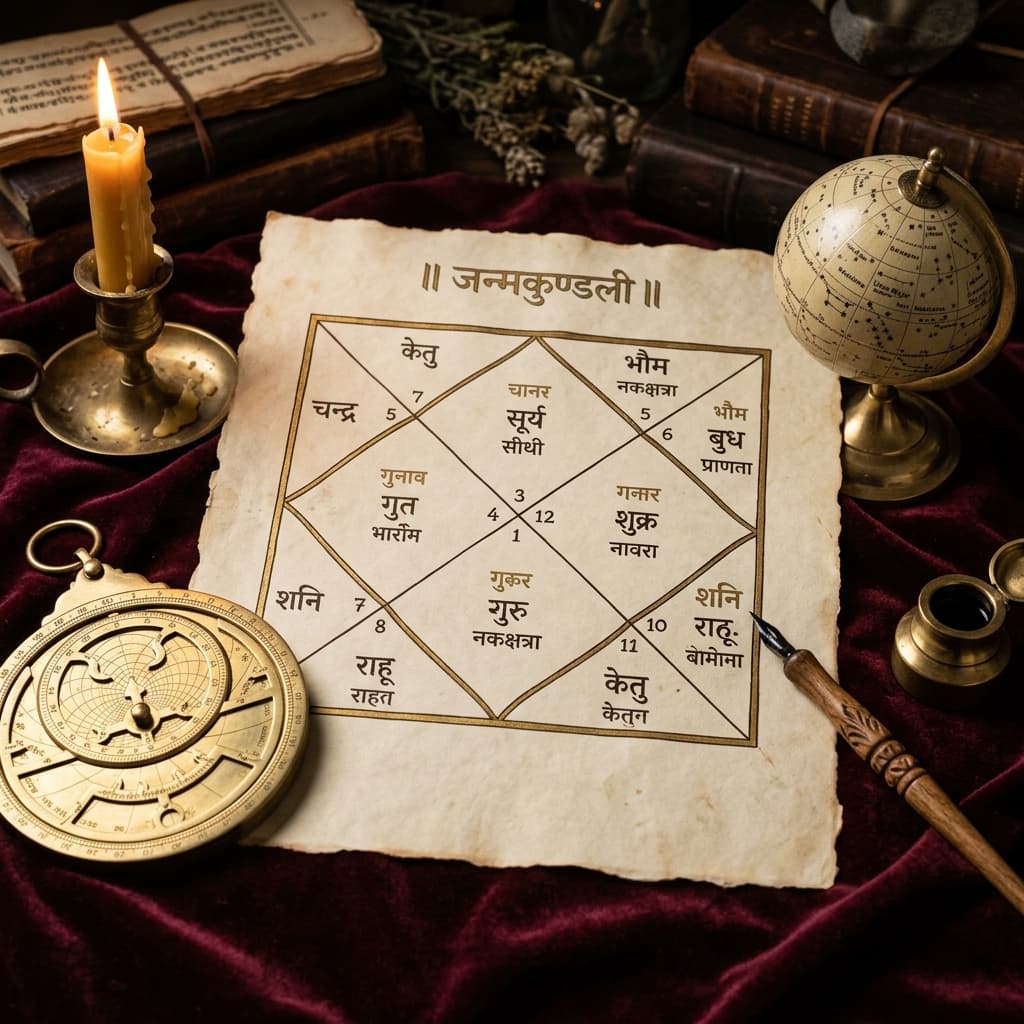
What Is a Janma Kundali? Your Cosmic Blueprint
A Janma Kundali — also known as a birth chart, natal chart, or Janam Patri — is a precise astronomical map of the sky at the exact moment and location of your birth. It captures the positions of the Sun, Moon, and all major planets (Grahas) across the 12 zodiac signs and 27 Nakshatras (lunar mansions), as seen from your specific birthplace.
In Vedic astrology, this chart is not merely a snapshot — it is considered the cosmic blueprint of your entire life. Every significant theme — your health patterns, intellectual abilities, career trajectory, relationship dynamics, financial potential, and spiritual evolution — is encoded within the positions, aspects, and combinations of planets in your Kundali.
The word "Kundali" derives from the Sanskrit "Kundala," meaning a coil or circle — referencing the circular nature of the zodiac through which planetary energies flow and interact. When a qualified Jyotish Acharya reads your Kundali, they are essentially decoding this cosmic language to reveal the tendencies, timing, and opportunities that your unique planetary configuration indicates.
Unlike newspaper horoscopes that generalise based on Sun sign alone, a Janma Kundali analysis is entirely personalised. No two Kundalis are identical — even twins born minutes apart will have subtle but meaningful differences in their charts, particularly in the rapidly-moving Lagna (Ascendant) and Moon placements.
The 12 Houses (Bhavas): Pillars of Your Birth Chart
The Kundali is divided into 12 houses (Bhavas), each governing a specific domain of life. Understanding which planets occupy and aspect each house is the foundation of any birth chart analysis:
1st House (Lagna) — Self & Personality
The Ascendant house defines your physical constitution, temperament, general health, and how the world perceives you. It is the single most important house in the chart and sets the tone for all other house interpretations.
2nd House — Wealth & Family
Governs accumulated wealth, family relationships, speech, and early education. Benefic planets here indicate financial security and a supportive family environment.
3rd House — Courage & Siblings
Rules over courage, communication skills, short journeys, younger siblings, and self-made efforts. A strong 3rd house produces entrepreneurs and self-starters.
4th House — Home & Mother
Represents domestic happiness, property, vehicles, mother's influence, and emotional security. This house is critical in Vastu assessments that cross-reference the birth chart.
5th House — Intelligence & Children
Governs intellect, creativity, education, children, romance, and speculative gains. The 5th house lord's placement reveals your learning style and creative potential.
6th House — Health & Enemies
Rules over disease, debts, enemies, competition, and daily work. While traditionally a "difficult" house, strong 6th house placements produce individuals who thrive under pressure and overcome adversity.
7th House — Marriage & Partnerships
The house of marriage, business partnerships, and public dealings. This house is extensively analysed during Kundali matching to assess marital compatibility, timing of marriage, and the nature of the spouse.
8th House — Transformation & Longevity
Governs sudden events, inheritance, occult knowledge, research, and longevity. Often misunderstood as purely negative, the 8th house also indicates deep transformation, healing abilities, and access to hidden knowledge.
9th House — Fortune & Dharma
The most auspicious house — representing luck, higher education, long-distance travel, father's influence, and spiritual wisdom. Strong 9th house placements indicate a fortunate life supported by divine grace.
10th House — Career & Status
Rules over profession, social status, authority, and public reputation. The 10th house and its lord are the primary indicators for career astrology predictions — revealing your ideal professional path and periods of peak achievement.
11th House — Gains & Aspirations
Governs income, profits, social networks, elder siblings, and the fulfilment of desires. The 11th house connects your efforts (3rd house) and career (10th house) to actual monetary and social rewards.
12th House — Losses & Liberation
Represents expenses, foreign travel, hospitalisation, and spiritual liberation (Moksha). A strong 12th house often indicates success abroad, deep meditation abilities, or a philanthropic nature.
Dashas and Transits: The Timing Engine of Vedic Astrology
What makes Vedic astrology uniquely powerful for prediction is its sophisticated timing systems. Two primary mechanisms determine when specific planetary influences will manifest in your life:
Vimshottari Dasha System
The Dasha system divides your entire life into major planetary periods (Mahadasha), each lasting between 6 and 20 years, followed by sub-periods (Antardasha) and sub-sub-periods (Pratyantardasha). The sequence begins from your Moon's Nakshatra at birth.
For example, a person entering Jupiter Mahadasha (16 years) may experience expansion in wisdom, career growth, and spiritual development — provided Jupiter is well-placed in their chart. Conversely, Saturn Mahadasha (19 years) emphasises discipline, hard work, and karmic lessons, but can bring tremendous lasting achievements for those who embrace its energy constructively.
Understanding your current Dasha period is essential for making informed decisions about career changes, marriage timing, investments, and health management.
Gochar (Transits)
While Dashas operate as long-term background rhythms, planetary transits provide the immediate triggers for events. Saturn's transit through a particular house (Sade Sati), Jupiter's beneficial transit, or Rahu-Ketu's axis shifts can activate or modify the promises indicated in the birth chart.
A skilled astrologer reads the Dasha and transit patterns together — like reading both the script and the stage directions of a play — to provide highly specific timing guidance. This dual approach is what allows an experienced practitioner to predict not just what may happen, but approximately when.
Important Yogas: Special Planetary Combinations
One of the most advanced aspects of Janma Kundali analysis is the identification of Yogas — specific planetary combinations that produce extraordinary results, either positive or challenging:
Auspicious Yogas
- Raja Yoga: Formed by the conjunction or mutual aspect of Kendra (1, 4, 7, 10) and Trikona (1, 5, 9) lords. Indicates authority, status, and success in public life. Multiple Raja Yogas in a single chart are exceptionally powerful.
- Dhana Yoga: Combinations involving the 2nd, 5th, 9th, and 11th house lords that indicate wealth accumulation and financial prosperity.
- Gajakesari Yoga: Jupiter in a Kendra from the Moon — one of the most celebrated Yogas, indicating wisdom, fame, and lasting prosperity.
- Budhaditya Yoga: Sun-Mercury conjunction producing sharp intellect, communication skills, and administrative abilities.
Challenging Yogas
- Kaal Sarp Dosha: All planets hemmed between Rahu and Ketu — often associated with cyclical struggles and delayed success, but also deep spiritual potential.
- Pitra Dosha: Afflictions to the 9th house or Sun indicating ancestral karmic debts that manifest as recurring obstacles in specific life areas.
- Shani Dosha: Saturn's challenging placements or aspects that bring delays and lessons but ultimately forge resilience and character.
Identifying these Yogas requires deep expertise — they are invisible to software and only recognisable to astrologers who have studied classical texts extensively. This is precisely why consulting the best astrologer — rather than relying on automated reports — makes a profound difference in the quality of guidance you receive.
Manual vs Software-Generated Kundali Charts
In the digital age, dozens of websites and apps offer free, instantly-generated Kundali charts. While these tools have democratised access to basic astrological information, there are critical limitations to be aware of:
What Software Does Well
- Accurate mathematical computation of planetary positions
- Quick generation of the basic chart layout
- Standard Ashtakoot matching scores
- Basic Dasha period calculations
What Software Cannot Do
- Contextual interpretation: The same planetary position means different things in different chart contexts. Software applies generic rules; an expert reads the entire chart as an interconnected system.
- Yoga identification: Many Yogas have subtle conditions and exceptions that software consistently misses or misidentifies.
- Remedial prescription: Effective remedies must be tailored to the individual's chart, current Dasha, and specific life situation — a level of personalisation that no algorithm achieves.
- Life context integration: A human astrologer considers your age, life stage, cultural context, and stated concerns when interpreting the chart — factors that transform a generic reading into genuinely useful guidance.
The ideal approach is to use software for the computational base, then bring that chart to a qualified Vedic astrologer like Acharya R.K. Mishra for expert interpretation. This combination of computational accuracy and scholarly wisdom produces the most reliable and actionable insights.
How a Kundali Reading Can Transform Your Decisions
A professional Janma Kundali analysis is not a passive fortune-telling exercise — it is an active decision-making tool that empowers you with awareness. Here is how clients typically benefit:
- Career clarity: Understanding your 10th house dynamics and current Dasha helps you make informed decisions about job changes, business launches, and professional development. Knowing that you are entering a favourable Jupiter period might encourage a calculated risk; knowing Saturn is transiting your career house might suggest consolidation rather than expansion.
- Marriage timing: The 7th house analysis and Venus/Jupiter transits can indicate the most favourable periods for marriage — information that is invaluable for families navigating the Kundali matching process.
- Health awareness: Planetary indicators for health vulnerabilities allow preventive action. If your chart indicates susceptibility to certain conditions during specific Dasha periods, you can proactively manage your lifestyle, diet, and medical check-ups during those windows.
- Financial planning: Dhana Yogas and the 2nd/11th house analysis reveal your wealth accumulation patterns and optimal investment timing.
- Spiritual growth: For those on a spiritual path, the 9th and 12th house analysis, along with Ketu's placement, reveals your natural spiritual inclinations and the practices most likely to accelerate your growth.
With over 35 years of experience and more than 15,000 consultations, Acharya R.K. Mishra brings a depth of interpretive expertise that transforms raw chart data into genuinely life-changing guidance. Every session is conducted personally — never delegated — ensuring you receive the full benefit of decades of accumulated wisdom.